Full Disclosure

(I rarely write about very personal situations, but I felt this one to be important. Plus, it’s how I dealt with it, really. When I don’t know what to do, I write. So here’s what I wrote.) 

There’s a line in a book, I don’t recall which, where the main character uses the phrase “my traitorous lungs.” I kept thinking of that, running the line through my mind over and over again, as I felt the lump under my arm. It was right on a lymph node, I suspected, having seen how far they stretch, how vast they run. And despite being scared, I just kept repeating the word over and over again – my traitorous body, my traitorous skin, my traitorous muscle – until it made just as little sense as the situation did.

You hear about these situations and assume they’ll never happen to you. I’m 28. I’m relatively healthy. I shouldn’t find lumps the size of the tip of my pinkie finger hiding out under my skin, polluting everything around it. I shouldn’t – and yet I did. So I called my doctor, scheduled an appointment for later that day, and logically planned my attack. Also, I cried.

Samir was out of town, and really I didn’t want to tell anyone about my will hopefully be nothing situation, so I took myself to the doctor after leaving work early. He felt the lump, confirmed my suspicion. It is, in fact, there. It is, in fact, a random mass. It definitely should be looked at. So that’s when I started to make the calls.

Having just gone through this with my mom – a year of breast cancer treatment  which, thankfully, is finally over – I was well accustomed to hearing the stats, scheduling the appointments, and, really, just playing it cool. That’s who I was during her time. I was the observer who jotted notes down to research later. Who asked the questions that needed to be asked. Who kept everyone calm. I resumed that role again as I scheduled my mammogram, as I told my mom, as I researched my situation. I played it cool because it was the only thing I knew how to do.

I hated referring to it as a mass, as a lump, as an anything thing that shouldn’t be in my body. So I named it Fred. Fred sounded less frightening. Fred wouldn’t hurt me.

Two days later, yesterday, I had my first mammogram. Most women start later, at 35 or 40. I started at 28. I sat in a room wearing a blue cloth gown tied tightly around myself as I noticed each woman walk in. Each woman was almost double my age. They all gave me the same “oh, poor you” face that I hated. I didn’t want sympathy. I wanted to leave.

My mammogram went smoothly, if not uncomfortably, and then the ultrasound was cold and wet and weird. I figured my first time having one would be when I was pregnant. I assumed wrong. I took a picture to text Samir, who was waiting for me patiently in the other room.
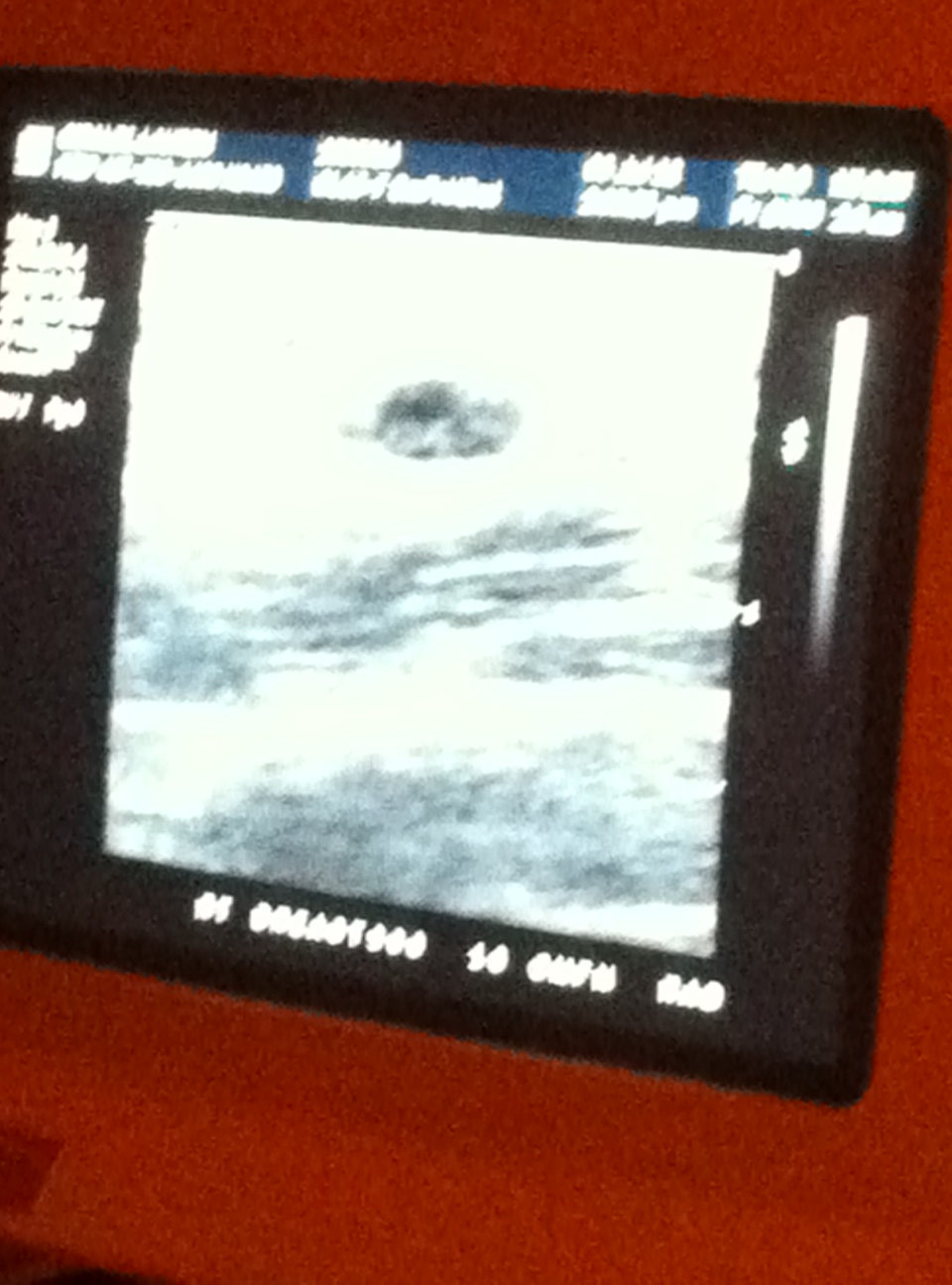
The black jellybean is Fred, my mass.

I waited, waited, waited for the results. It’s cliche, but it did feel like it took a full day. A week. A month. But the doctor came in and showed me the films, showed me the pictures.

And I was right about so many things. Fred was on my lymph node. Fred was quite large, 5 mm. It was smart to get Fred looked at.

But despite all that? Fred was nothing. Fred was, in fact, simply an enlarged lymph node.

And I was completely fine. 

I think I asked her if I was okay at least seven times. Perhaps eight. I think it took me at least seven minutes to process the information. Perhaps eight.

Of course everything was great after that. I called my parents, my friends who sent me encouraging texts throughout the day. It was over, and I was fine.

But here’s the thing – while everything was fine, and Fred was just something I’ll live with, I’m really glad I still got him checked out. Because he could have been worse, he could have been horrible. There’s a part in The Art of Racing where the wife refuses to go to the doctor because she knows there will be bad news. I didn’t understand that when I read it – why refuse to know? But sitting under the ultrasound, I understood. Sometimes not knowing is easier. Especially when you know it will be bad.

But easier isn’t always better, and not knowing is not always the right way to go. We got my mom checked out just in time and it ended up being bad. I got myself checked out in time and it ended up being good. You really don’t know which way it’ll end, but in the end i’m so lucky that my mom is okay now…

…and, yeah, so am I.

Wanderlust

From the outside, my friend Shannon and I are remarkably similar. We’re both short, with her just 1.5 inches taller than me. We both have long, unruly brown hair that naturally curls and waves. We both have terrible eye-sight and wear plastic, brown glasses. We were both in the circus, and were roommates, and have a strange tendency to say the same words at times. We make similar faces. We love Disney movies.

But the similarities end there because, despite being best friends, we’re polar opposites. I crave stability, knowing where I am and what I’m doing. I have a job, a husband. We’re looking into buying a house soon. We have an apartment full of stuff and while all that might sound boring, it’s also reassuring and comfortable. I love living like this, I love knowing I’m okay. Shannon, on the other hand, is a wanderer. She can fit her entire life into her car. She’s moved to different states just for fun, and in a week she’s moving out of the country. Her job is tentative, but she doesn’t care. To her, it’s an experience, a chance to travel, a chance to live.

And yet, somehow our friendship works perfectly.

I realized that the other day as we were walking down our street (she is, at this moment, my neighbor). As we talked, my mind floated above us and instead of seeing us as who we are, I saw us as characters in a book. Her the girl who follows wanderlust and me the one who stays planted. It was neat seeing us like that, imagining what craziness we’d get up to as these characters. How, in theory, we should probably drive each other crazy, but how in actuality, we’re the perfect match.

Because in a way, we bring out something in one another. For her, I show her that stability is okay. She’s admitted to wanting to settle down one day. I make sure she’s okay; remind her to keep us updated during her travels in case of, well, emergencies. I bring out the logic in her.

And me? She made me go to a state park on my one day off. Usually I reserve that day for writing or bills or errands, but she took me to the springs and for the full afternoon we laid by the water, ate snacks, and took in the day. And it was fantastic. It’s not like I’d never been to the park before, I had many a time, but lately I’d been so wrapped up in feeling old and professional that I forgot what it was like to drop everything and live.

So I did. And I didn’t think of everything I had to do at home. I wrote notes in my journal for the book I’m working on because, as it turned out, this serenity made words come easier to me. And later, when we met up with a few friends, I didn’t care that I was wearing shorts from college that had paint stains on them. I didn’t care that my nose was the color of Rudolph’s and my freckles were at full visibility (that said, I quite like my freckles). I didn’t care that the spring water made my hair into a mass of curls and tangles. I just smiled and laughed and felt pretty.

Because I was living.

I know I can’t be like that all of the time – it’s not me – but I also know that I can add her influence just a bit. I know when she’s away, she’ll make sure things are in order because I gave that to her. And I know when she’s away I’ll spend more time doing rather than thinking because the sand is still on my sandals and I have no desire to wipe it off.

Putting it to sleep

Sometimes writing needs to breathe. It needs air, space, time to develop into what it wants to be. It needs to rest, and not be pressed into what it isn’t. It needs to understand that nothing else can be done at the time being, but perhaps, hopefully, the future can change that. Sometimes, it just needs to take a nap to be recharged.

Book 2, or, TSWB, is at that stage. For the past month or so I’ve been editing it – fixing the grammar and story and character names. I’ve been piecing together parts that were missing; fixing parts I knew could be written better. So now, it’s a complete story. It’s there. And it’s…fine. Overwhelmingly fine. I love the characters, but I feel like the plot needs work. And I’m not sure what kind of work.

So i’ve decided to let it sleep for a while. Once I tried pushing and prodding, I knew nothing would happen. I’m too close to it right now, too confused. Like a relationship, we just need a small break to remind ourselves of what we like about one another. To remind me of what I once saw it in. To let me fall in love all over again.

So that’s what I’m doing right now. I’m not giving up on it, oh no, I like it far too much. But I am putting it aside for the time being to let it grow and mature on its own. Because I know in a bit, when I open up the document again, I’ll know exactly what to do to make it what I want it to be. What it should be. And what it was meant to be.

Have you ever put a piece of writing to the side? How was it when you were reunited? 

Perks Moment

I feel like everyone has their own Perks of Being a Wallflower moment. The moment they discovered the book and felt like it was written entirely for them. Well, with the release of the movie’s trailer, I was reminded of mine –

It was the summer of 2002 and I was working at Borders. I remember shelving the small books and being instantly intrigued by the minimal yellow cover. It was so cute. And the title was very…me. I had always felt like a wallflower. So I bought it and brought it home and read it.

And read it again. And again. And again.

It was the summer after my freshman year of college and while I was four years older than the protagonist, I knew how he felt. It was just so real. So I started reading it every year.

Now, there are two types of book owners I’ve realized: a) those who believe books are a work of art and prefer to keep them as pristine as possible and b) those who believe the more worn a book looks, the more loved it is. I subscribe to the second belief. My books are very loved.

So while reading, I started underlining my favorite sentences, passages, so I could easily go back to them. When I got back to college (I was home in Orlando during the summer; my school was in Tallahassee), I handed the book off to my good friends, instructing them to read it and underline their favorite passages. To me, the book felt like a letter I had to share, one that everyone made their own. I loved seeing the different underlined passages because while we all loved the I felt infinite moment, we each had different parts that spoke to us just as well. (My favorite line is the one underlined above. It’s simple, and perfect.)

In the process of handing it off so often, my copy started to wear down. Pages were lose, ripped. And then, one day, a friend spilled an oil candle on it. At first, I was upset; my book was ruined, gone, dead. But then, when the pages dried, I saw that there wasn’t any harm, really, and the only permanent damage was that it kind of smelled like cinnamon apple.

And I was okay with that.

Because every time I went into a Cracker Barrel I thought of Perks. Every time I went into one of those country, good-time shops, I thought of Perks. And I smiled.

Years later I taught high school english. On my first day, as a very scared 22 year old, I passed around surveys to my students to learn a bit more about them. Who was an athlete, who was a drama kid. The last question asked them what their favorite book was.

One student said Perks.

It wasn’t a Bill and Charlie moment; we didn’t become best friends or anything like that, but I was so happy to see that the book transcended generations. That the same book that spoke to me so many years prior still applied to teenagers today.

Which was when I realized that I could relate to these students. While I didn’t have a cell phone at their age, I did understand what it was like to be a wallflower.

And I think that’s the most important part of the book. It makes you feel understood, and connected to a larger group of people you might not have known otherwise. Good books can do that.

And this one certainly did.

Have you read The Perks of Being a Wallflower? What’s your story? What’s your favorite line? 

Equals

Last year my friend Ernest met Miley Cyrus and Liam Hemsworth. He didn’t recognize them immediately, that is until a few people pointed it out. But if you know Ernest, you know he has this amazing ability to make everyone feel like a friend. He didn’t freak out, didn’t treat them like rich, famous celebrities. Instead, he hung out with them as if they were me, as if they were S. They ate, drank,  had a great time, and even ended the night with a dance off . (You can read the full story here.)

Now, I’m not mentioning this to brag about my cool friends (although, you guys, I have really cool friends).

When I started teaching years ago, I was told to treat my high school students like, well, teenagers. Like kids. And in a way, sure, I did. I wanted to protect them, teach them, nurture them. But when talking to them? No way. I treated them like adults. Because you know what teens hate? Being thought to be children. Being talked down to. So instead of belittling them, I treated them as I’d treat my friends (only, you know, in a more professional, teacher-appropriate way).

And it worked. I had some of the most amazing students, many of which still message me with brilliant updates. We had a mutual respect, but they were never afraid to tell me about problems they were having, or colleges that accepted them.

I’m bringing the same thought to librarianship now. I’m in charge of reviving teen programming at the library and for the past few months i’ve been talking to our teen patrons about what they’d like to have here. What kind of programs and books and movies and things they’re interested in. And you know what? I’ve met some of the coolest teens in the process. One talked to me about YA mysteries for 20 minutes. Another high fived me for being a fellow nerdfighter. Another even confided in me that school kind of sucks, but books make her happy. A co-worker laughed at me (in a good way), commenting on my innate ability to relate to teens. And I loved that comment. You see, not once did I treat any of the teens like children. I treated them as equals because, you know, they are.

I take this approach with writing, too. I won’t write down to teens; never will I assume they can’t understand, or can’t grasp a concept. Because they’re smart, more mature than many people think. They are our future, after all.

So here’s my advice for today: treat everyone like a friend. Be nice, be equals. Don’t talk down. Because you never know when it will lead to an inspiring moment, or a new friend. Or, even, a crazy dance off.